
In the beginning, they were two: the land and the sea”
In 2013, China attracted significant international attention following the announcement of one the most ambitious investment projects ever conceived: The Belt and Road Initiative (BRI). The BRI aims to promote greater connectivity on a transcontinental scale, notably through massive infrastructure development and trade enhancement. This initiative has developed into a fundamental element of China’s foreign and economic policies, responding to the “convergence of interests and increasing need for regional and global economic cooperation”.
In the early stages, the BRI consisted of two main components: the Silk Road Economic Belt (land) and the 21st Century Maritime Silk Road (sea). The former, inspired by the ancient trade networks spanning Eurasia, was originally devised to connect East Asia to Europe by land, while the latter aimed to link China’s coastal regions to the rest of Asia and the Middle East. Over the years, the project expanded to Africa, Latin America, and Oceania, welcoming all willing participants.
In the Global South, particularly in African countries, the BRI is increasingly seen as a catalyst for regional (global) economic integration and competitiveness. Tangible results that have lasting effects on the economic and social development of BRI African economies can be found in the form of infrastructural achievements such as a standard gauge railway in Kenya, an electric railway in Ethiopia, or even hydropower stations in Uganda. China has signed over 200 cooperation documents with nearly 150 countries, generating a cumulative engagement of approximately US $ 960 billion since 2013.
In 2015, the NDRC, the Ministry of Foreign Affairs, and the Ministry of Commerce formally introduced a third dimension of the BRI in a white paper, calling for the development of “an information silk road”. It laid out the vision for a “Digital Silk Road” (DSR) to be built in cyberspace.
“Three to be complete: understanding the Digital Silk Road”
Whereas the Belt and Road Initiative, shaped by land and sea components, has been concentrating on massive infrastructure development projects, the Digital Silk Road aims to improve digital connectivity and promote digital economic growth in participating countries. The DSR uses technologies “that will serve as a foundation of a new digital economy”.
From a relatively simplistic point of view, the Digital Silk Road can be regarded as the cyber and technological element of the larger Belt and Road Initiative. Given its fast-changing and multidimensional nature, the DSR concept often remains poorly understood, both as “government initiative and commercial endeavor”. Furthermore, the existing documentation provides a nebulous and sometimes contradictory explanation, making it even more complex to define. Hence, the concept has mutated into an “umbrella term for various activities in the cyber realm”.
The Digital Silk Road can also be perceived as an effort to develop technological capacities mainly outside of China, with the direct participation of Chinese firms, Chinese advisors, and the integration or expansion of the market for Chinese goods and services.
It is essential to bear in mind that technological change is occurring at a rapid pace, broadly similar to China’s private-sector technology industries. The perception in a year’s time of what the DSR comprises might differ from our current understanding. In 2022, the technological sector experienced a tremendous increase in engagement in BRI countries, precisely a 7536% growth compared to the previous year. The DSR is becoming a pivotal element of the BRI, promoting the global vision of a “shared future” through technology areas and projects.
“Digital Roots in Africa”
China’s digital influence in African countries predates the Digital Silk Road initiative, particularly in the telecommunications industry with firms such as Huawei and ZTE. The implementation of Chinese companies in this specific area is a consequence of the continent’s telecommunications revolution, which began in the 1990s.
Given their competitive pricing, cost-effective equipment and solutions, and government-subsidized funding, Chinese companies have been able to dominate the market in a great number of African nations. They have massively contributed to the development of key telecoms infrastructure, from optical fiber backbone networks to “last-mile solutions”.
In the past few years, the telecommunications sector has experienced considerable advances, following the rapid development in the use of mobile telephony and internet technology. Chinese firms have been committed to revamping the industry, actively engaging in upgrading activities, and providing new solutions. In 2020, 46% of Sub-Saharan Africa’s population had a mobile subscription, and estimates indicate that this number is expected to reach 50% by 2025.
“Towards a Win-Win Cooperation”
In this era of rapid technological change, societies are increasingly shifting towards Internet-based economies. Digitalization implies a profound transformation of all sectors of activity, with “data” as a key factor of mutation, ultimately becoming a precondition for development.
Many African nations are now recognizing that economic development won’t be achievable without the digital “element” and are taking concrete actions through the adoption of “digital agendas”, which are reflected in:
1) digital strategic plans (strategic plans covering distinct items such as e-commerce);
2) national development plans (national development plans outlining the digital agenda such as digital infrastructure development); 3) disparate documents, policies, laws, and initiatives
Trends in Africa’s digital agenda
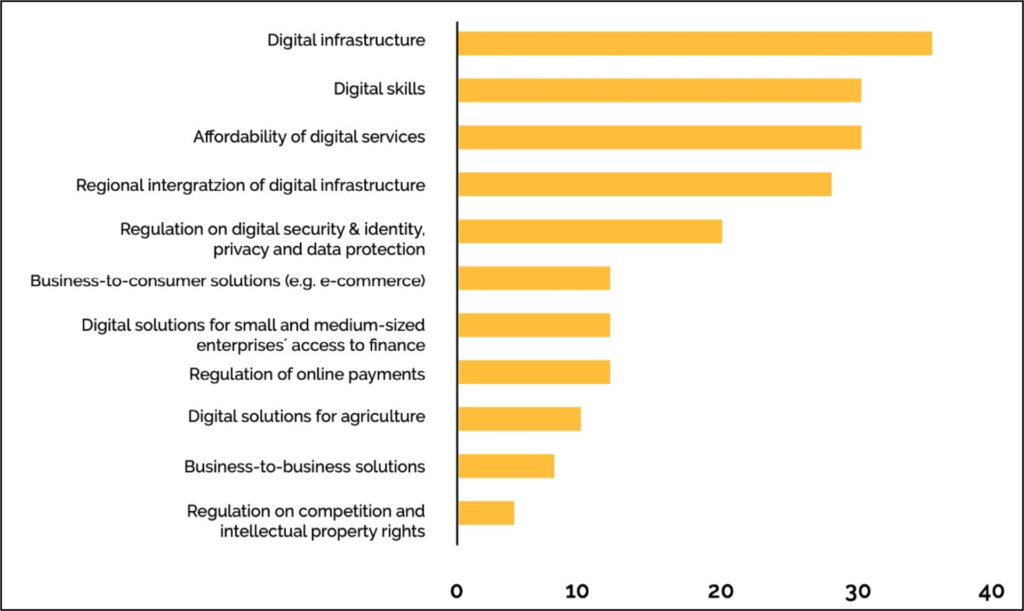
Source: AUC/OECD 2020 Expert Survey on Digitalization in Africa – APRI – apri.africa
Digital infrastructure development remains a key priority for several African governments, given that it constitutes a necessary condition for digital transformation. To date, approximately 36% of the continent has established fiber-optic networks — cables containing strands of fiber optic glass that can transmit information with almost no limits on distance or capacity — and built e-government platforms. According to GSMA estimates, 83% of the population in Sub-Saharan Africa is covered by 3G networks, while 4G networks account for about 58%.
With the Digital Silk Road, China has been devoted to narrowing the connectivity gap in BRI African countries, striving to help build stronger partners across the region. The DSR represents a unique chance to revitalize, reinforce, and diversify Africa and China (win-win) cooperation.
Overview of “win-win” cooperation areas in the Digital Silk Road
| Key areas | Africa’s win | China’s win |
| Digital infrastructure | Digital infrastructure development | Tackling domestic ICT manufacturing sub-sector overcapacity (e.g. optical cable industry overcapacity, exceeding 50%) |
| Digital skills | Digital literacy enhancement Digital skills development (narrowing the existing gap; promoting digital entrepreneurship) | Exporting China’s technical expertise (digital skills building) |
| Business-to-consumer/business solutions | E-commerce development (building an adequate ecosystem; connecting local businesses to broader markets) | Building an e-commerce Silk Road (Alibaba’s effort to construct an Electronic World Trade Platform (eWTP) |
| Regulation on digital security, privacy and data protection | Cybersecurity development (establish appropriate legislative frameworks) | Exporting China’s expertise in digital security |
| Digital solutions for SMEs to access to finance | Fintech development (consolidating digital financial services; strengthening existing fintech ecosystems) | Exporting China’s digital payment expertise and fintech governance |
On one side, there are African countries, rapidly realizing the significance of technology in their development processes and are determined to catch up with the digital transformation momentum. On the other side, there is China, widely recognized as an innovation powerhouse and a high technology tank with its own standards, facing industrial overcapacity issues that are affecting domestic advanced-technology industries.
The Digital Silk Road provides unprecedented opportunities to solidify Africa-China win-win cooperation: it is a response to Africa’s huge digital potential, large and untapped youth population (longing for connectivity), and fast-growing economies; it is an occasion for China to export its technological know-how, ensure greater connectivity between countries in both worlds (cyber and physical), tackle domestic overcapacity, ultimately “building a community with a shared future for mankind”.
Written by: Dr. Nancy A. Lohalo, Senior Research Fellow, ACCPA


