
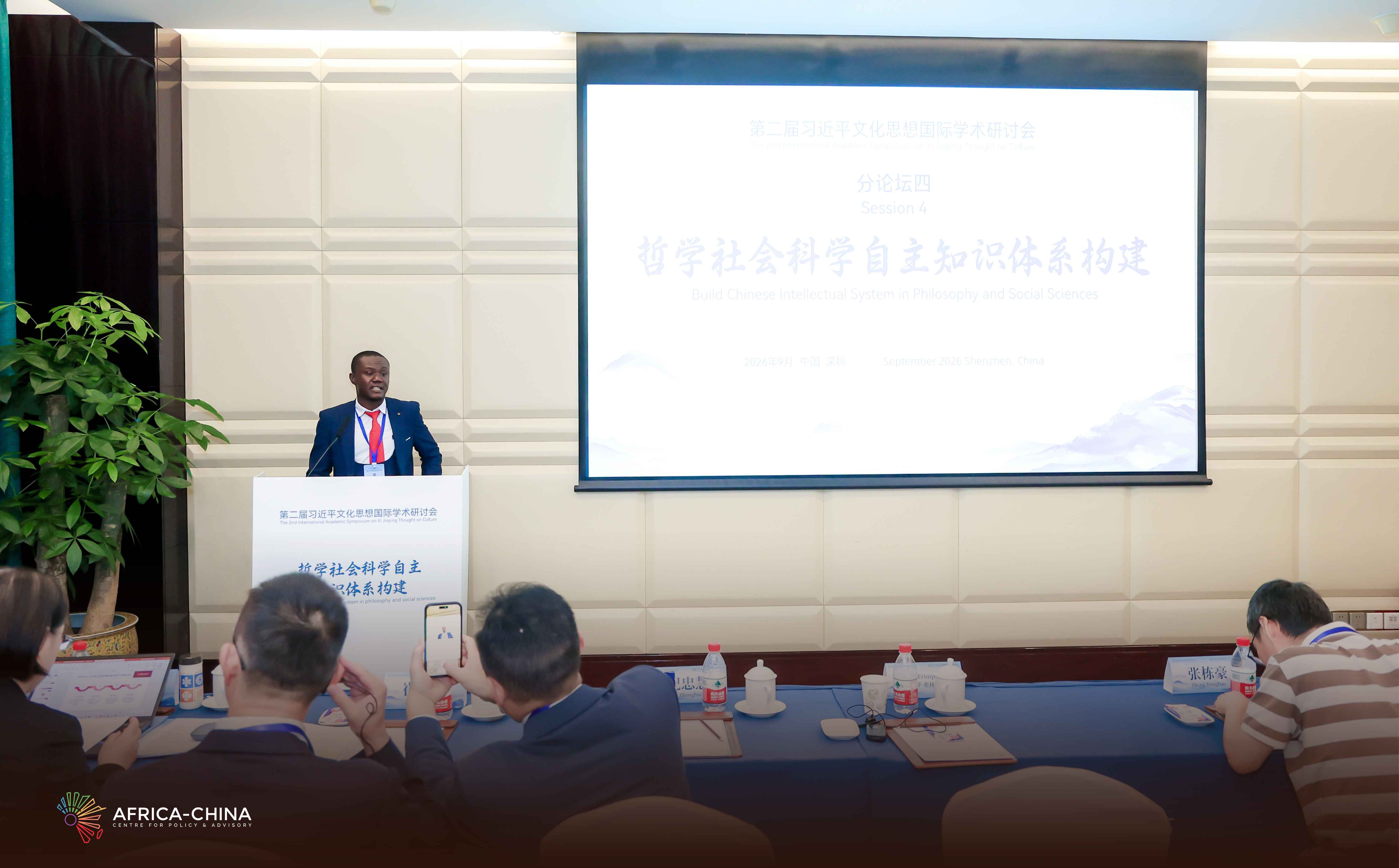
The Founder and Executive Director of the Africa-China Centre for Policy and Advisory (ACCPA), Paul Frimpong, has called for a more equal and reciprocal intellectual relationship between Africa and China—one that recognises Africa not merely as an audience for Chinese ideas, but as an active partner in global knowledge production.
Mr. Frimpong made the call while addressing the International Academic Symposium on Xi Jinping Thought on Culture, held from 6–7 September 2026 in Shenzhen, China.
The high-level symposium attracted more than 300 participants, including scholars, policy experts and representatives of leading universities and think tanks from different parts of the world. Mr Frimpong was the only African scholar represented at the international gathering, bringing a distinct African perspective to the discussions.
The symposium was jointly hosted by the Xinhua Collaborative Research Base of the Xi Jinping Thought on Culture Research Center, South China Normal University and the Publicity Department of the CPC Guangdong Provincial Committee.
Held under the theme, “Upholding Cultural Subjectivity in Promoting Chinese Modernization,” the symposium examined the practical relevance and global significance of Xi Jinping Thought on Culture.
Delivering a speech titled, “From Cultural Subjectivity to Intellectual Dialogue: An African Perspective on Building a Chinese Intellectual System,” Mr Frimpong argued that every society must possess the confidence and capacity to interpret its history, institutions and development experience through concepts rooted in its own realities.
He observed that students in Africa frequently encounter explanations of both Africa and China through intellectual frameworks developed elsewhere, raising an important question about who possesses the authority to interpret societies and define their development experiences.
“What happens when societies learn to understand themselves mainly through intellectual frameworks created by others?” he asked.
According to Mr Frimpong, China’s efforts to develop an intellectual system grounded in its history, culture and modernization experience are particularly relevant to Africa, where educational and knowledge institutions continue to bear the influence of colonial history.
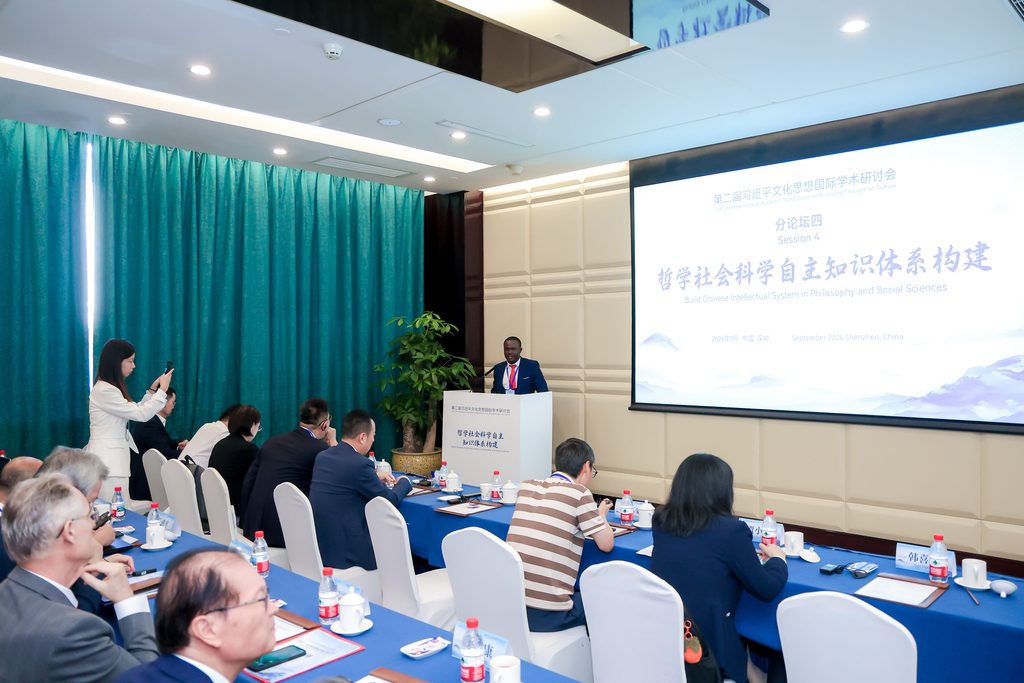
IMAGE: Paul Frimpong, Executive Director of ACCPA, delivering his address at the 2nd International Academic Symposium on Xi Jinping Thought on Culture in Shenzhen, China.
He explained that cultural subjectivity should not mean rejecting ideas from other societies. Rather, it should enable countries to engage the wider world from a position of intellectual confidence.
“The objective is not intellectual isolation, but intellectual independence: the confidence to speak from our own experiences while remaining open to learning from others,” he stated.
Mr Frimpong cautioned, however, against replacing the historical dominance of one intellectual tradition with another single centre of global intellectual authority. He instead advocated a more plural global knowledge system in which different civilizations contribute ideas without losing their distinct identities.
He maintained that the international influence of a Chinese intellectual system would depend not only on how confidently it explains China, but also on its willingness to listen, engage and evolve through dialogue with other intellectual traditions.
In this process, he said, Africa must be recognised as a source of knowledge capable of contributing to debates on modernization, governance, development, community and cultural continuity.
Mr Frimpong proposed four pathways for building an Africa–China community of knowledge: genuine joint knowledge production; reciprocal translation and accessibility of scholarship; sustained partnerships among universities and think tanks; and the co-creation of concepts arising from African and Chinese experiences.
He stressed that African institutions should not serve merely as sources of data for research projects designed elsewhere. African and Chinese scholars must jointly define research questions, methodologies and priorities.
“Africa should therefore not be treated only as a place where Chinese ideas are introduced, but as an intellectual partner capable of questioning, enriching and advancing those ideas,” he emphasised.
He also called for important Chinese works to be made more accessible to African scholars and students, while African intellectual traditions and contemporary scholarship receive greater visibility and engagement in China.
Concluding his address, the ACCPA Executive Director noted that intellectual confidence should encourage openness rather than closure. The future of global knowledge, he said, should enable societies to encounter ideas from Africa, China and elsewhere as distinct voices within a shared human conversation.
“A strong intellectual system must have roots deep enough to sustain its identity, but bridges wide enough to connect with humanity,” he concluded.