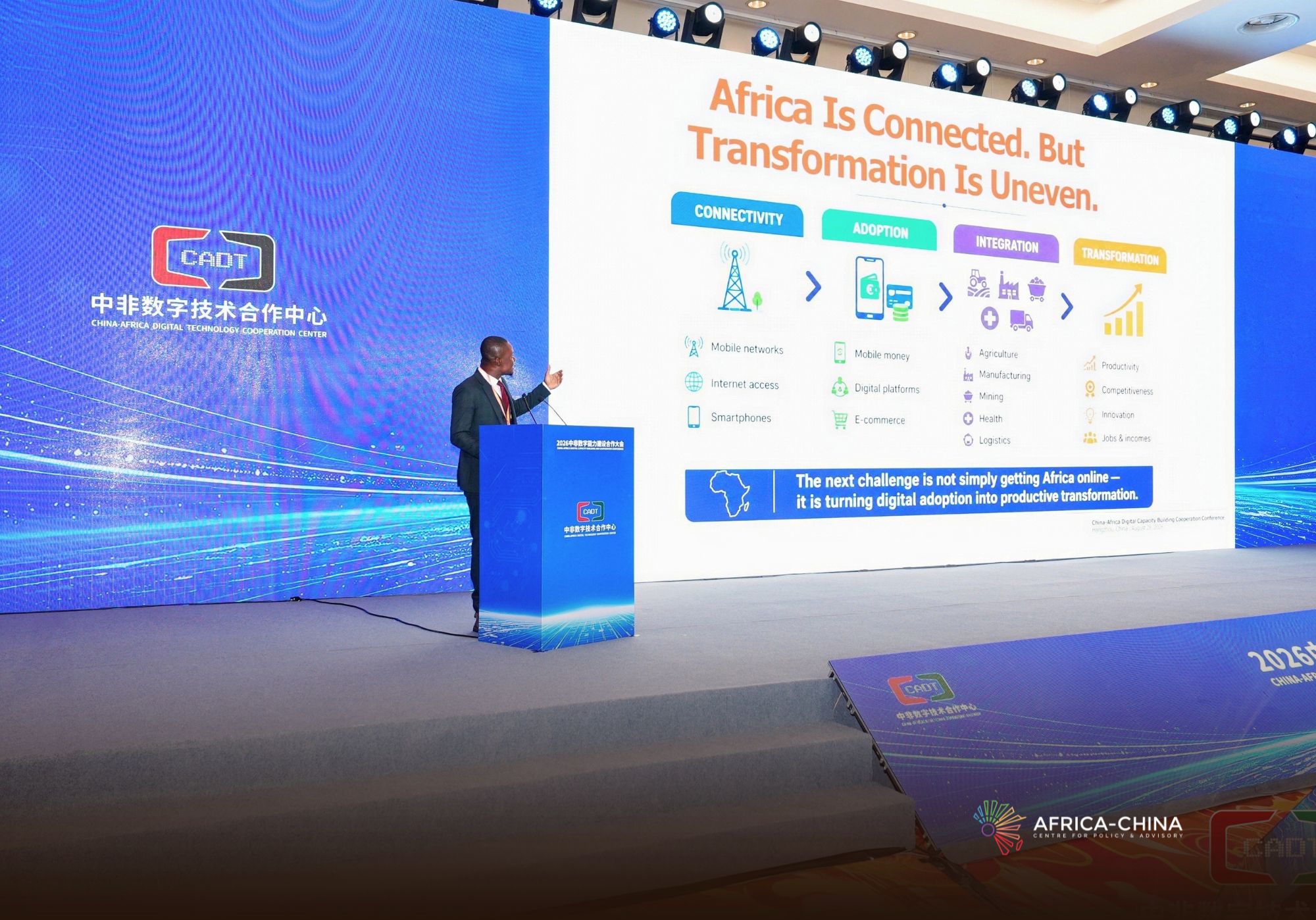
Digital Adoption Is Not Digital Transformation
Digital adoption and digital transformation are not the same. A country may expand connectivity, digitise public services and install advanced systems while remaining dependent on external equipment, software, expertise and finance. Such adoption can improve access and efficiency, but it becomes transformative only when it changes how an economy learns, produces and competes. This distinction is central to Africa’s engagement with China, whose expanding digital partnership offers significant opportunities alongside new dependencies. The question is therefore not simply what technologies African countries can acquire, but how China–Africa cooperation can build the knowledge, institutions and productive capabilities required to shape their own digital futures.
Africa’s Digital Adoption–Capability Gap
Africa’s digital economy presents a striking paradox. The continent has pioneered mobile money and rapidly embraced digital platforms, e-commerce and online public services, yet it captures only a limited share of the value embedded in the technologies it uses. Much of the underlying hardware, software, cloud infrastructure, intellectual property and investment capital originates elsewhere.
This dependence is not inherently problematic; all economies participate in international technology networks. The risk arises when institutions cannot evaluate, maintain or modify imported systems, and when local firms can operate only through foreign platforms, cloud services and financing. Under these conditions, adoption expands without a corresponding accumulation of knowledge or productive capacity. Countries may become more digitally connected while remaining technologically dependent.
Closing this gap does not require Africa to manufacture every component or achieve technological self-sufficiency. It requires sufficient domestic capability to make informed choices, negotiate effectively, adapt technologies to local needs and capture greater economic value. The challenge is therefore to convert widespread digital use into sustained learning, enterprise growth and technological agency.
What Technological Capability Actually Means
Technological capability is often confused with manufacturing every component domestically. In practice, it begins much earlier: with the ability to understand a technology, judge whether it addresses a real need, and negotiate its acquisition from an informed position. It also means having local engineers and institutions capable of installing, operating, repairing, and modifying systems without permanent dependence on external providers.
At a more advanced level, capability includes conducting applied research, solving technical problems, producing selected components, developing software and services, and generating locally owned intellectual property. It also requires regulators who can govern emerging technologies and businesses capable of converting technical knowledge into competitive products.
These abilities do not reside in government alone. They are distributed across universities, technical institutions, research centres, regulators, private enterprises, engineers, and entrepreneurs. Their interaction determines whether imported technology becomes a foundation for domestic learning or simply another dependency. Technological capability is therefore not the ability to produce everything at home; it is the collective capacity to understand, choose, govern, adapt, and increasingly create technology on terms that advance national development.
Reimagining the 20 Demonstration Projects as Capability Platforms
The 20 demonstration projects proposed under FOCAC should be treated as platforms for learning and capability building, not merely as installations to be commissioned and counted. Their design should begin with joint identification of the development problem, followed by meaningful African participation throughout implementation.
Training should be embedded in the work itself. African engineers and technicians should learn through installation, operation and maintenance, while universities and technical institutions participate in research, adaptation and evaluation. Local firms should receive credible subcontracting and procurement opportunities, rather than being confined to peripheral services. Where appropriate, partners should also provide access to technical documentation and operational knowledge necessary to maintain and improve the systems.
Each project must therefore answer two questions: What immediate problem does the technology solve, and what capability will remain after the external experts leave? A successful pilot should produce local professionals who understand the system, institutions capable of governing it, firms able to support it and a practical pathway for replication.
Every demonstration project should ultimately deliver two outputs: a functioning technological solution and a measurable body of African capability. Without the second, a successful installation may still represent a missed development opportunity.
Building the Domestic Foundations for Meaningful Cooperation
External partnerships cannot compensate for weak domestic foundations. African governments will benefit more from digital cooperation when it is guided by coherent digital-industrial strategies that identify where technology can raise productivity and address national priorities. These choices should reflect local conditions: one country may prioritise digital agriculture and logistics, while another focuses on manufacturing, financial technology, healthcare or digital public infrastructure.
Implementation also requires coordination across ministries responsible for technology, industry, education, trade and finance. Without such alignment, infrastructure may be installed without the skills, financing or industrial policies needed to generate wider economic value. Governments must therefore invest in universities, technical education and applied research while building stronger links between academic institutions and industry. Local technology firms also require support beyond short-term competitions and pilot programmes, including access to finance, public contracts and opportunities to participate in larger projects.
Reliable electricity, affordable connectivity, and secure data infrastructure remain equally essential. Public procurement can then be used strategically to create demand for local expertise and innovation. Ultimately, countries negotiate external partnerships more effectively when they know what they want. In the absence of a domestic strategy, available technologies and external financing may determine project selection, producing disconnected interventions instead of structural transformation.
Governing the Partnership: Contracts, Data and Accountability
Meaningful digital cooperation also depends on how projects are negotiated and governed. Procurement should be transparent and competitive, with financing terms, operating expenses, and long-term maintenance costs clearly established before implementation. Contracts should include realistic local-content, skills-development, and technology-transfer provisions, alongside safeguards against dependence on a single provider.
Data-intensive projects require particular scrutiny. Agreements must clarify who owns the data generated, where it will be stored, who may access it and how it may be used. Cybersecurity, system resilience, interoperability, privacy and civil liberties should be treated as core design requirements rather than concerns addressed after deployment. Independent evaluation is also necessary to determine whether projects deliver their promised social and economic outcomes.
These concerns are not unique to cooperation with China; they apply to partnerships with every major external technology provider. Strategic engagement requires neither automatic acceptance nor blanket suspicion. It requires institutions capable of evaluating competing technologies, understanding contractual risks, negotiating appropriate terms, and protecting the public interest. Strong governance does not obstruct digital cooperation; it makes that cooperation more credible, sustainable, and developmentally valuable.
From National Projects to Continental Scale
Fragmented national markets limit Africa’s ability to capture value from digital cooperation. Many countries lack the market size, financing, and specialized expertise required to build complete digital ecosystems independently. Regional cooperation can pool these resources, reduce duplication, and create sufficient scale to attract investment and support the growth of African technology companies.
The African Union and regional economic communities should therefore connect national projects to continental priorities, while the African Continental Free Trade Area provides a framework for integrating digital markets. Harmonized data governance and digital trade rules would make it easier for technologies and services to operate across borders. Shared infrastructure, interoperable payment systems, and common technical standards could similarly reduce costs and improve connectivity. Regional research and innovation networks would allow universities and technical institutions to combine expertise that may be limited within individual countries.
Greater coordination could also strengthen Africa’s bargaining position when negotiating major technology projects. Rather than developing isolated national pilots, countries could jointly identify needs, procure appropriate solutions, and share implementation lessons. The 20 demonstration projects should consequently produce models that can be adapted across countries and regions, turning individual interventions into building blocks for a more integrated African digital economy.
Conclusion
China–Africa digital cooperation offers significant opportunities, but its outcome is not predetermined. Africa’s digital future will depend on whether access to technology is converted into knowledge, productive capacity, and institutional strength. The goal is not technological isolation but technological agency: the capacity to choose, adapt, govern, and increasingly create digital solutions. Cooperation becomes a genuine development partnership when African actors move beyond receiving technologies to shaping how they are designed, applied, and developed.