Overview
As the global push toward decarbonization accelerates, the energy transition is reshaping economic competitiveness, industrial strategy, and geopolitical alignments. China has emerged as a global leader in renewable energy manufacturing, green finance, and clean technology innovation, while Africa stands at a pivotal juncture — pursuing sustainable industrialization while meeting its climate and development priorities.
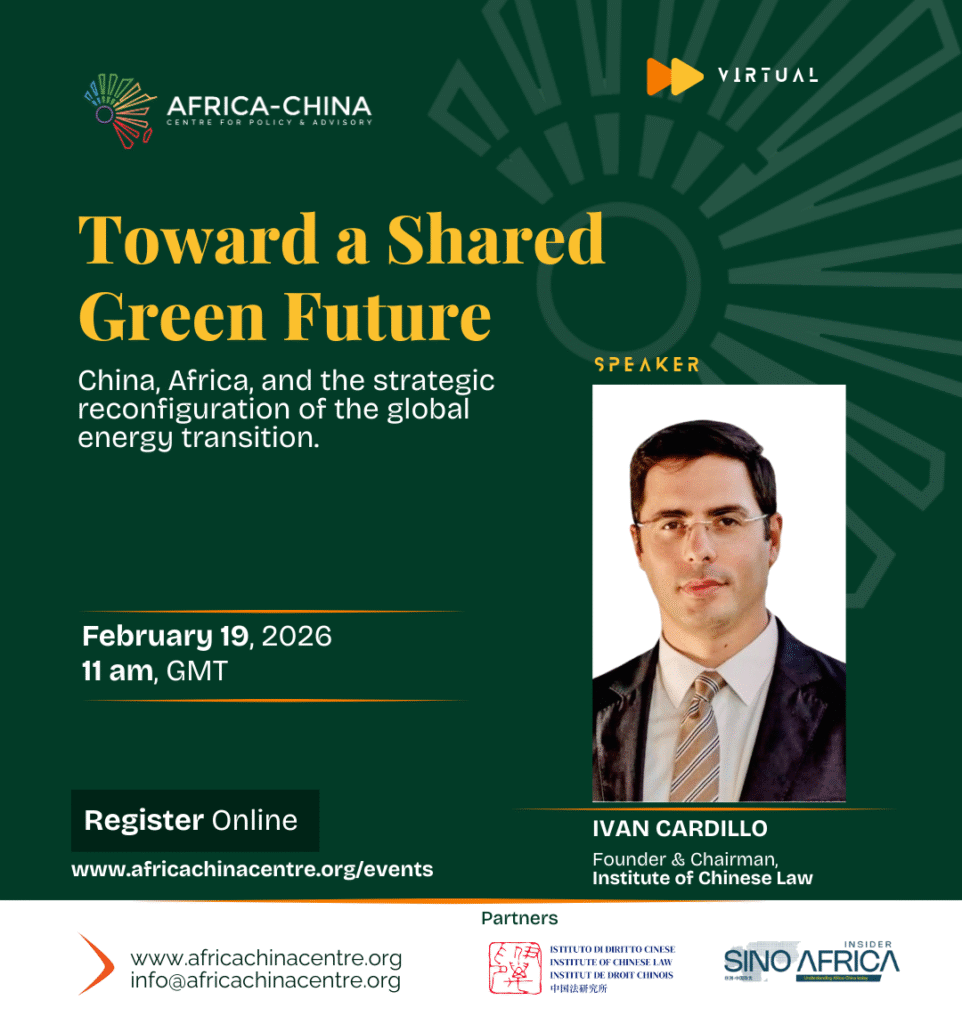
Hosted by the Africa–China Centre for Policy & Advisory (ACCPA) in partnership with the Institute of Chinese Law, this high-level webinar brings together policy, legal, and development perspectives to examine how Africa–China cooperation can evolve in a decarbonizing world.
The session will explore regulatory, institutional, and strategic frameworks shaping green investment, renewable energy deployment, and sustainable value chains across both regions, advancing practical collaboration toward a just and inclusive energy transition.
Ready to join us?
Objectives
Examine the evolving role of China in the global energy transition.
Explore Africa’s strategic position within emerging green value chains.
Identify practical pathways for Africa–China cooperation in renewable energy, green finance, and sustainable industrialization.
Highlight opportunities for policy innovation, investment alignment, and long-term climate collaboration.
The session seeks to move the conversation from rhetoric to actionable partnership.

Why Attend
- A strategic understanding of how Africa and China fit into the shifting global energy architecture.
- Insight into green industrial policy trends shaping emerging markets.
- Practical perspectives on financing mechanisms and partnership models
- Clarity on risks, governance gaps, and how to avoid repeating resource-dependent development patterns.
- Forward-looking analysis relevant to both public and private sector actors.
This is not just a conversation about energy — it is about economic transformation, sovereignty, and long-term competitiveness in a decarbonizing world.
Who Should Attend
- Government officials and policymakers working on energy, climate, trade, and industrial development.
- Development finance institutions and green investment actors.
- Think tank researchers and academics focused on Africa–China relations or climate policy.
- Private sector leaders in renewable energy, manufacturing, and infrastructure.
- Civil society actors engaged in sustainable development and just transition advocacy.
- Students and emerging professionals interested in global energy governance.